

India Fires Back at Pakistan at UNGA:
"Kashmir Is Ours — Period"
At the 2026 UN General Assembly, India's top diplomat dismantled Pakistan's Kashmir narrative in real time — warning the world body against being used as a stage for misinformation.
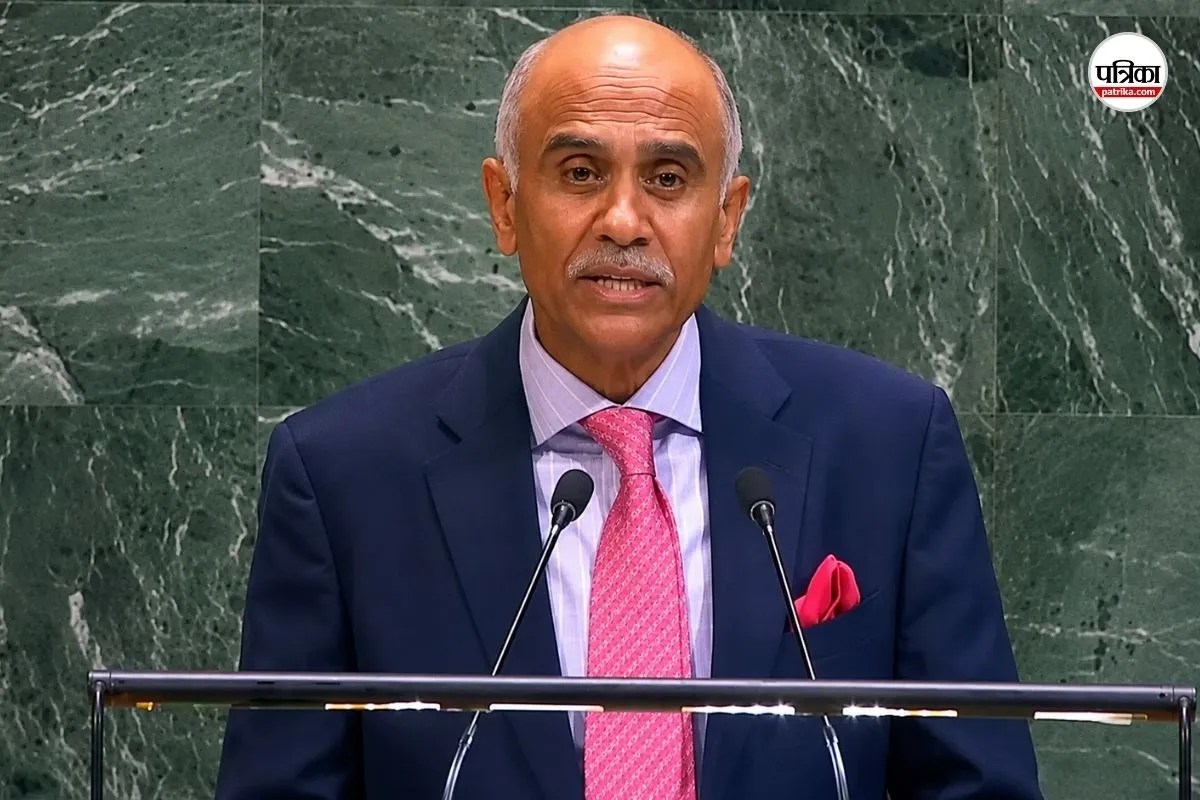
India's Permanent Representative P. Harish speaking at the UN General Assembly — June 2026.
New York, United Nations — June 6, 2026: In a sharp and unambiguous rebuke delivered on the floor of the United Nations General Assembly (UNGA), India's Permanent Representative P. Harish tore apart Pakistan's attempt to internationalize the Jammu & Kashmir issue — calling it a deliberate exercise in spreading a "misleading and biased narrative" on a prestigious global platform.
The confrontation unfolded during the UNGA's annual debate on the UN Security Council's report, when Pakistan's Permanent Representative Asim Iftikhar Ahmed raised the Kashmir issue — a move India swiftly and forcefully countered.
📌 Key Highlights
- India's P. Harish called out Pakistan for misusing the UNGA platform for political motives.
- He reaffirmed that Jammu & Kashmir is India's "integral, inseparable, and inalienable" part.
- India also rejected Pakistan's plan to hold elections in Gilgit-Baltistan on June 7.
- Pakistan's tenure as a non-permanent member of the UN Security Council ends by late 2025.
- Pakistan dismissed India's objections as "baseless."
India's Iron-Clad Stand: "No Debate, No Discussion"
Speaking on behalf of India, P. Harish left no room for ambiguity: all matters relating to Jammu & Kashmir are entirely India's internal affairs. He declared that the Union Territory is — and will always remain — an integral, inseparable, and inalienable part of India. Any claims suggesting otherwise, he said, are not only baseless but go against the grain of historical fact.
"Pakistan's hollow rhetoric and false allegations can never change this fundamental truth. Jammu & Kashmir was, is, and will always remain an integral part of India."
This is not the first time India has been compelled to counter Pakistan's attempts to raise the Kashmir issue at international forums. However, the June 2026 session has drawn particular attention given the heightened India–Pakistan tensions in the backdrop of the Operation Sindoor military standoff and the subsequent ceasefire earlier this year.
A Warning to the UN: Stop Being Misused
P. Harish went beyond defending India's position — he delivered a pointed message to the broader UN membership. Reminding delegates that UN General Assembly membership comes with serious responsibilities, he accused Pakistan of repeatedly abusing the UN's prestigious platforms to serve its narrow political agenda.
He argued that Pakistan keeps raising issues that have no connection to ground reality, with the sole aim of misleading the international community. "This pattern of behavior," he noted, "undermines the credibility and integrity of multilateral institutions."
Diplomatic observers have noted that Pakistan's habit of raising the Kashmir issue at the UN intensifies whenever it faces domestic political pressure or when its global standing is under scrutiny — both of which apply to the current moment.
Pakistan's UN Seat — Running Out of Time
Pakistan currently holds a non-permanent seat on the UN Security Council, but its two-year term is set to expire by the end of 2025. Analysts suggest that the repeated invocation of the Kashmir issue in these final months is part of a strategic push to extract maximum diplomatic mileage before exiting the high-visibility Security Council forum.
Pakistan Raises Kashmir at UNGA
Asim Iftikhar Ahmed brings up J&K during the UN Security Council's annual report debate.
India Delivers Sharp Rebuttal
P. Harish categorically rejects Pakistan's claims, calling J&K India's integral territory.
India Protests Gilgit-Baltistan Election
India's Ministry of External Affairs condemns Pakistan's plan to hold elections in illegally occupied Indian territory.
Pakistan Dismisses India's Objections
Pakistan's Foreign Office calls India's statements "baseless" and rejects them entirely.
Gilgit-Baltistan: India Rejects Illegal Elections
The diplomatic fireworks at the UNGA came alongside a separate but related flashpoint: Pakistan's plan to hold general elections for the so-called Gilgit-Baltistan Legislative Assembly on June 7, 2026.
India's Ministry of External Affairs (MEA) responded with unequivocal condemnation. The MEA stated clearly that Gilgit-Baltistan is an integral part of India, over which Pakistan has illegally and forcibly established control. The ministry noted that holding elections in occupied territory cannot confer any legitimacy on Pakistan's unlawful presence there.
The MEA statement was particularly pointed in its description of conditions on the ground: Pakistan's illegal occupation has brought human rights violations, political repression, economic exploitation, and severe restrictions on civil liberties. Attempting to conduct elections in such an environment, India said, was nothing but a smokescreen to mask these deep-rooted abuses.
The Human Cost Pakistan Wants You to Forget
India's MEA was unusually blunt in lifting the veil on conditions inside Pakistan-occupied territories. The statement described a reality that international media rarely covers:
Residents of these territories reportedly face systematic political suppression — dissenting voices are silenced, political participation is controlled, and economic resources are extracted to benefit Pakistan's core provinces. Civil society organizations have long reported that the people of Gilgit-Baltistan and Pakistan-occupied Kashmir are denied the fundamental freedoms taken for granted in democratic societies.
"These cosmetic electoral exercises cannot hide Pakistan's long and dark record of abuse in the territories it illegally occupies," the MEA stated, adding that India completely rejects any attempt by Pakistan to alter the status of Indian territories under its occupation.
Pakistan's Response: Denial as Usual
Pakistan's Foreign Office, true to form, rejected India's objections regarding the Gilgit-Baltistan elections as "completely baseless" and dismissed them wholesale. Pakistan has long maintained that both Jammu & Kashmir and Gilgit-Baltistan are "disputed territories," a claim that India rejects as legally and historically unfounded.
This war of words at the UN is the latest chapter in a decades-long diplomatic battle — but observers note a distinct difference in India's tone in recent years. Far from being defensive, India's responses have become increasingly assertive and detailed, countering Pakistani claims with historical context, legal arguments, and pointed references to Pakistan's own governance failures.
What This Means for India–Pakistan Diplomacy
The June 2026 UNGA exchange signals several important diplomatic realities. First, India has no intention of allowing the Kashmir narrative to go unchallenged at any international forum, regardless of how frequently Pakistan raises it. Second, India is actively reframing the conversation — from "disputed territory" to Pakistan's "illegal occupation" of Indian land, including Gilgit-Baltistan and Pakistan-occupied Kashmir.
Third, and perhaps most significantly, India is becoming bolder in holding Pakistan accountable for its human rights record in territories it controls — a counter-narrative that puts Pakistan on the defensive rather than India.
As the international community watches the post-ceasefire India–Pakistan situation closely, the message from New Delhi is unmistakable: the diplomatic battle for the truth about Kashmir is far from over — and India intends to win it.
Source: Based on reporting by Patrika News (June 6, 2026). India's rebuttal was delivered at the UNGA session during debate on the UN Security Council's annual report.